
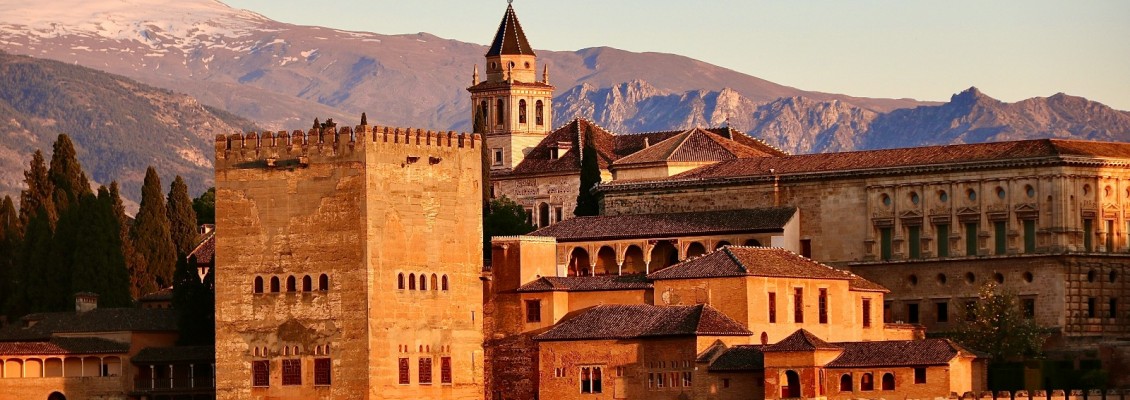
THE ALHAMBRA PALACE
Islam is not a religion confined solely to the Arabian Peninsula. Along with spreading in the hearts of believers across the world, it has also left remarkable works in many different regions through the Islamic states that were established. One of the countries that once hosted an Islamic state is Spain. The Umayyad State of al-Andalus was founded in 756 and ruled until 1031. After its fall, Muslims continued to live in Spain in small principalities. During this period, Islamic culture greatly influenced Spain and its language. Even today, it is possible to see traces of Islamic art in Spain and the influence of Arabic in certain Spanish words.
During their time in Spain, Muslims produced many magnificent works of architecture and art. One of the most striking of these is the Alhambra Palace. Located in Granada, the palace has suffered various damages throughout history but has managed to survive, preserving its fame as a splendid monument. The palace’s original name is Qasr al-Hamra, and it was built in Granada, the capital city of the Nasrid (Banu al-Ahmar) dynasty. There are several opinions about the origin of its name. The most accepted view is that the word al-Hamra, meaning “the Red,” refers to the reddish hue of the clay mortar used in its construction. Surrounded by massive walls and towers, the palace stands on a broad hill overlooking the Darro River. The complex consists of three main sections: the royal palace housing the emir and his family at the highest point, the al-Qasaba (citadel) serving as a military garrison to the west, and the residential area for nobles, craftsmen, and officials to the east.
The history of the Alhambra dates back to the last quarter of the 9th century, when it was originally built as a fortress for defensive purposes. With the establishment of the Nasrid State, this area gained greater importance. The founder of the dynasty, Muhammad ibn Yusuf, ordered the construction of a larger settlement around the existing fortress which is what we now know as the Alhambra. The aim was not merely to expand the fortress, but to establish a royal city. This project was completed over more than 150 years with the contributions of successive rulers, reaching its final form in the 15th century. Different sections of the palace were built over time:
· During the reign of Muhammad II (1273–1302): the al-Qasaba, the Wine Gate (Puerto del Vino), the Rawda (Emirs’ Cemetery), the Hall of the Abencerrajes (Sala de los Abencerrajes), and the Generalife summer palace (Jannat al-‘Arif).
· During Muhammad III (1302–1309): the al-Portal area and the Royal Mosque (Mezquita Real), where the Church of Santa María now stands.
· During Ismail I (1314–1325): the Hall of Council (Mexuar), where administrative and judicial matters were discussed, and the Comares Palace and its baths.
· Most of the structures that remain standing today were built during the reigns of Yusuf I (1333–1354) and Muhammad V (1354–1359, 1362–1391). New towers and gates were added, and the palace baths were rebuilt. The famous Courtyard of the Lions (Patio de los Leones), one of the most iconic features of the Alhambra, was constructed during Muhammad V’s reign. Another remarkable structure from this period is the Comares Palace. After this era, few new buildings were added, except for the Tower of the Infantas (Torre de las Infantas), built under Muhammad VII (1392–1408).
In addition to these, the Alhambra contains many other rooms and pools. Later rulers also made modifications and additions after the end of Islamic rule.
When speaking of the Alhambra, one of the first arts that comes to mind is calligraphy. Aware that God cannot be represented in any form, Muslims avoided using figurative imagery in their architecture. Instead, calligraphy became a central feature in both religious and civil architecture. One inscription that can be found almost everywhere in the Alhambra reads: “La ghalib illa Allah” — “There is no victor but God.” This phrase still carries meaning today: kingdoms rise and fall, but no power lasts forever. Only God is the true victor.
Leave a Comment